The Management Layer Problem: Why Mid-Market Enterprises Are Losing Ground to Their Own Org Charts
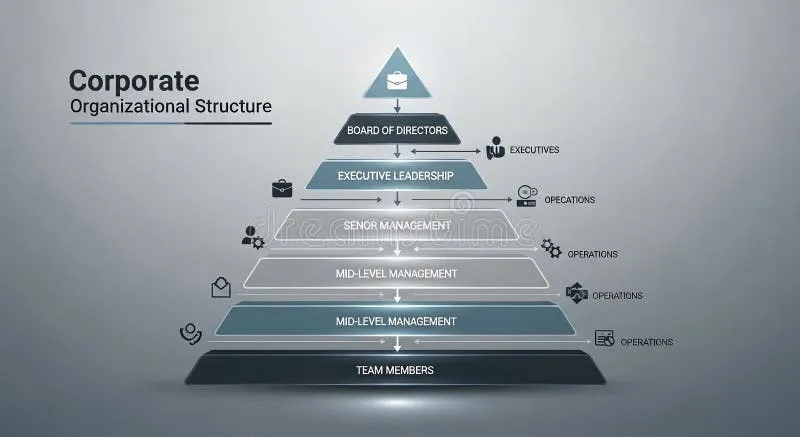
Photo: corporate organizational hierarchy meeting boardroom executives mid-market business, via thumbs.dreamstime.com
There is a particular kind of organizational paralysis that doesn't announce itself with a crisis. It doesn't show up in a quarterly earnings call or trigger an emergency board meeting. It accumulates slowly — in delayed approvals, in meetings about meetings, in talented employees who stop raising their hands because they've learned that good ideas get buried three layers deep before anyone with authority ever hears them.
For mid-market U.S. enterprises — those operating somewhere between the scrappy startup phase and the institutional weight of a Fortune 500 — this condition is remarkably common and remarkably costly. The culprit, more often than executives are comfortable admitting, is middle management: not the people themselves, but the structural role they've been placed in.
How the Bottleneck Forms
Most mid-market companies develop their management layers organically. A team of twelve becomes a division of sixty. A single operations director spawns three regional managers, each overseeing their own coordinators. The org chart expands not because someone designed it that way, but because headcount grew and the default response was to add supervisory layers.
The problem is that this approach treats management as a ratio problem — a certain number of employees per manager — rather than a design problem. And when management is structured by ratio rather than by function, the result is a hierarchy optimized for oversight rather than execution.
Decisions that should take hours begin taking weeks. A product manager in the Midwest identifies a pricing adjustment that could recapture a slipping customer segment. The idea moves to a regional director, then to a VP of sales, then to a cross-functional committee, then back down for "alignment." By the time approval arrives, the competitor has already moved.
This isn't a hypothetical. According to research from McKinsey & Company, companies with excessive management layers make decisions up to six times more slowly than their leaner counterparts — and in industries where speed-to-market is a competitive variable, that gap is existential.
The Hidden Costs That Don't Appear on a Balance Sheet
The financial impact of management gridlock is real, but much of it is invisible to standard accounting. Enterprises rarely categorize "delayed market response" as a line-item loss. They don't report "employee disengagement caused by bureaucratic fatigue" as an operational expense. Yet the costs accumulate in ways that eventually surface in revenue trends, attrition rates, and customer satisfaction scores.
Consider talent retention. High-performing employees — particularly those in the 28-to-40 demographic who are building their careers and evaluating their futures — consistently cite organizational bureaucracy as a primary reason for leaving. When a capable analyst or project lead watches their recommendations cycle through four approval stages only to emerge unrecognizable or rejected without explanation, they begin updating their résumés. Replacing that employee costs, by most industry estimates, between 50 and 200 percent of their annual salary. Multiply that across a mid-market enterprise experiencing even modest turnover, and the math becomes sobering.
There is also the opportunity cost dimension. Every initiative that stalls in a management queue represents a window that may close. Markets shift. Competitors adapt. Customer expectations evolve. The enterprise that can identify an opportunity and respond in two weeks consistently outperforms the one that requires two months to convene the right stakeholders.
Case Studies in Structural Reform
Several mid-market U.S. enterprises have confronted this challenge directly — and the results offer instructive lessons.
A regional logistics firm headquartered in Ohio found itself losing contract renewals at an unusual rate. Exit interviews with departing clients cited slow response times and an inability to customize service agreements quickly. Internal analysis revealed that contract modifications required sign-off from five separate managers across two departments. The company restructured its operations team, consolidating approval authority into two roles and empowering frontline account managers to execute modifications up to a defined dollar threshold without escalation. Within eighteen months, contract renewal rates improved by 22 percent.
A B2B software company in Texas faced a different version of the same problem. Product development cycles were running significantly over schedule, and post-mortems consistently identified "waiting for stakeholder alignment" as the primary delay factor. Leadership introduced a tiered decision model: decisions below a certain complexity and risk threshold were delegated entirely to product team leads, mid-level decisions required one executive sponsor rather than committee consensus, and only strategic pivots required full leadership review. Development velocity increased by roughly 30 percent in the following year.
Neither company eliminated middle management. Both recognized that experienced managers remain essential for mentorship, quality control, and institutional continuity. The transformation was structural, not personnel-driven: redefining what decisions required escalation and what decisions should be resolved at the point of execution.
A Diagnostic Framework for Enterprise Leaders
Before any structural reform can begin, enterprise leaders must accurately assess whether their current management architecture is serving the business or constraining it. The following questions offer a starting framework.
How long does a standard operational decision take from identification to execution? If routine decisions — pricing adjustments, vendor selections, staffing reallocations — consistently require more than five business days and multiple approvals, the structure warrants examination.
Where do initiatives stall most frequently? Map a recent project from inception to completion and identify every point at which it waited for a response. If the majority of delays occurred at management handoffs rather than at execution stages, the hierarchy is the bottleneck.
What percentage of your middle managers spend the majority of their time in approval workflows versus strategic contribution? Managers who function primarily as approval conduits rather than strategic contributors are a structural symptom, not an individual performance issue.
How do your high performers describe decision-making at your organization? Anonymous pulse surveys that specifically probe organizational agility often reveal what formal reporting structures obscure.
Designing for Execution, Not Just Oversight
The goal of management restructuring is not to flatten organizations indiscriminately. Span-of-control matters. Experienced judgment is irreplaceable. What mid-market enterprises need is a management architecture that distinguishes between decisions requiring deliberation and decisions requiring speed — and routes each accordingly.
This means defining decision rights explicitly: who owns what category of decision, at what level, and under what circumstances escalation is genuinely warranted. It means training managers to develop the judgment of their direct reports rather than serving as the default decision-maker. And it means creating accountability structures that reward execution velocity alongside accuracy.
For U.S. enterprises competing in markets where agility is increasingly a differentiator, the management layer is not a neutral organizational feature. It is either an accelerant or an anchor. The companies that grow fastest in the next decade will be those that design their hierarchies with the same intentionality they bring to their technology investments and market strategies.
The invisible ceiling is real. But unlike market forces or macroeconomic headwinds, it is entirely within the enterprise's power to dismantle.