Power, Price, and Pressure: How U.S. Enterprises Are Rethinking Energy as a Core Business Risk
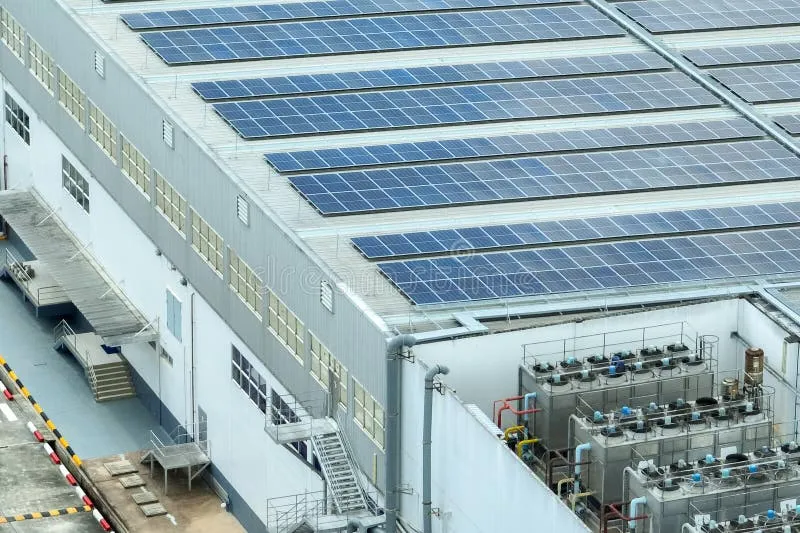
Photo: corporate energy management solar panels industrial facility USA, via thumbs.dreamstime.com
For decades, energy was treated as a fixed overhead line — predictable, manageable, and largely invisible to the executive suite. That assumption has collapsed. Across the United States, commercial and industrial energy prices have experienced sustained volatility driven by fuel market disruptions, extreme weather events, and a transmission grid that was not designed to serve the demands of a modern digital economy. For enterprise leaders, the question is no longer whether energy costs will affect profitability. The question is how severely, and how soon.
The stakes are particularly acute for asset-intensive sectors. A mid-sized data center operator in Texas, a plastics manufacturer in Ohio, or a cold-storage logistics company in Georgia all share a common vulnerability: their operational continuity is directly tied to the reliability and affordability of power they do not control. When the grid falters — or when wholesale prices spike — the downstream financial consequences are immediate and compounding.
The Grid Was Not Built for This Moment
The United States power grid is, in many regions, a mid-twentieth-century infrastructure system carrying twenty-first-century loads. According to the American Society of Civil Engineers, a significant portion of the country's transmission infrastructure is operating beyond its intended design life. Aging transformers, insufficient interstate transmission capacity, and uneven investment in grid hardening have created a system that performs adequately under normal conditions but becomes a liability during stress events.
For enterprises, this is not an abstract infrastructure policy concern. It is a direct operational risk. Power outages and voltage irregularities cost U.S. businesses an estimated $150 billion annually, a figure that has grown as digital dependency increases across virtually every industry vertical. When a server farm loses power for four hours, the cost is not simply the electricity it did not consume — it is lost transactions, violated service-level agreements, reputational damage, and potential regulatory exposure.
The reliability problem is compounded by a pricing problem. Deregulated energy markets in states like Texas, Illinois, and Pennsylvania expose commercial buyers to real-time price fluctuations that can make accurate financial forecasting extraordinarily difficult. Enterprises that locked into fixed-rate contracts before recent market disruptions found themselves either overpaying relative to spot prices or — in the case of those on variable-rate structures — absorbing jaw-dropping invoice increases that had no precedent in their operating history.
From Cost Center to Strategic Asset: The Case for Energy Portfolio Thinking
The enterprises that are navigating this environment most effectively have made a fundamental cognitive shift: they no longer treat energy as a commodity to be purchased at the lowest available rate. They treat it as a portfolio to be actively managed.
This portfolio approach has several dimensions. On the procurement side, sophisticated buyers are employing layered hedging strategies — combining fixed-rate contracts for baseline load, indexed contracts for flexible consumption, and power purchase agreements (PPAs) with renewable generators to introduce both price stability and long-term cost predictability. The PPA market, once the exclusive domain of large technology companies, has matured considerably. Mid-market enterprises with credit-worthy balance sheets now have access to structures that were unavailable to them five years ago.
On the physical infrastructure side, on-site generation is moving from a niche resilience investment to a mainstream competitive tool. Battery energy storage systems (BESS), combined heat and power (CHP) installations, and rooftop or ground-mount solar arrays are increasingly being evaluated not on their environmental merits alone, but on their hard-dollar return on investment. An enterprise that can island its critical operations during a grid disturbance is not merely protected — it has a tangible advantage over competitors who cannot maintain continuity under the same conditions.
What Manufacturing and Data Center Operators Are Doing Differently
Two sectors illustrate the divergence between enterprises that have adapted and those that have not.
In domestic manufacturing, energy-intensive producers — particularly in chemicals, metals, and food processing — have invested heavily in demand response programs. By agreeing to curtail consumption during peak grid stress periods in exchange for capacity payments or rate incentives, these companies have effectively monetized their operational flexibility. A manufacturer that can shift a non-critical process by four hours is not sacrificing productivity; it is generating revenue from its own load management capability.
Data center operators, meanwhile, have become among the most sophisticated energy buyers in the commercial sector. Hyperscale facilities routinely employ teams of energy traders, negotiate directly with utilities for custom tariff structures, and are increasingly locating new capacity in regions with access to abundant renewable generation and favorable transmission costs. For enterprise IT leaders who rely on colocation or cloud infrastructure, the energy strategies of their providers have direct implications for service reliability and, increasingly, for the sustainability disclosures their own boards are demanding.
Building an Enterprise Energy Resilience Framework
For organizations that have not yet formalized their approach to energy risk, the starting point is an honest assessment of exposure. This means understanding not just what a facility pays for power, but what an hour of downtime actually costs across all operational and financial dimensions. Until that number is clearly established, it is impossible to make rational investment decisions in resilience infrastructure.
From that baseline, a practical framework involves three sequential priorities. First, reduce consumption through efficiency investments — LED retrofits, HVAC upgrades, and industrial process optimization often deliver payback periods of two to four years with minimal operational disruption. Second, optimize procurement by engaging an independent energy advisor to evaluate contract structures against actual load profiles and market conditions. Third, invest in resilience assets — backup generation, battery storage, or on-site renewables — calibrated to the specific downtime cost identified in the initial assessment.
None of this is simple, and none of it is cheap in the near term. But the enterprises that treat energy as a strategic business function rather than a facilities expense are consistently demonstrating better operational performance, more predictable cost structures, and greater resilience when market or weather conditions deteriorate.
The Bottom Line
The energy paradox facing American enterprises is real: the infrastructure that powers the modern economy is simultaneously less reliable and more expensive than the business models built upon it were designed to accommodate. Companies that wait for grid operators or regulators to resolve this tension on their behalf are accepting a risk they have the capacity to manage.
Enterprise leadership — from CFOs evaluating capital allocation to COOs responsible for operational continuity — has both the incentive and the tools to reframe energy as a core strategic concern. The organizations that act on that reframing today will not simply reduce their utility bills. They will build a form of operational resilience that compounds in value every time the grid fails to deliver on its promises.